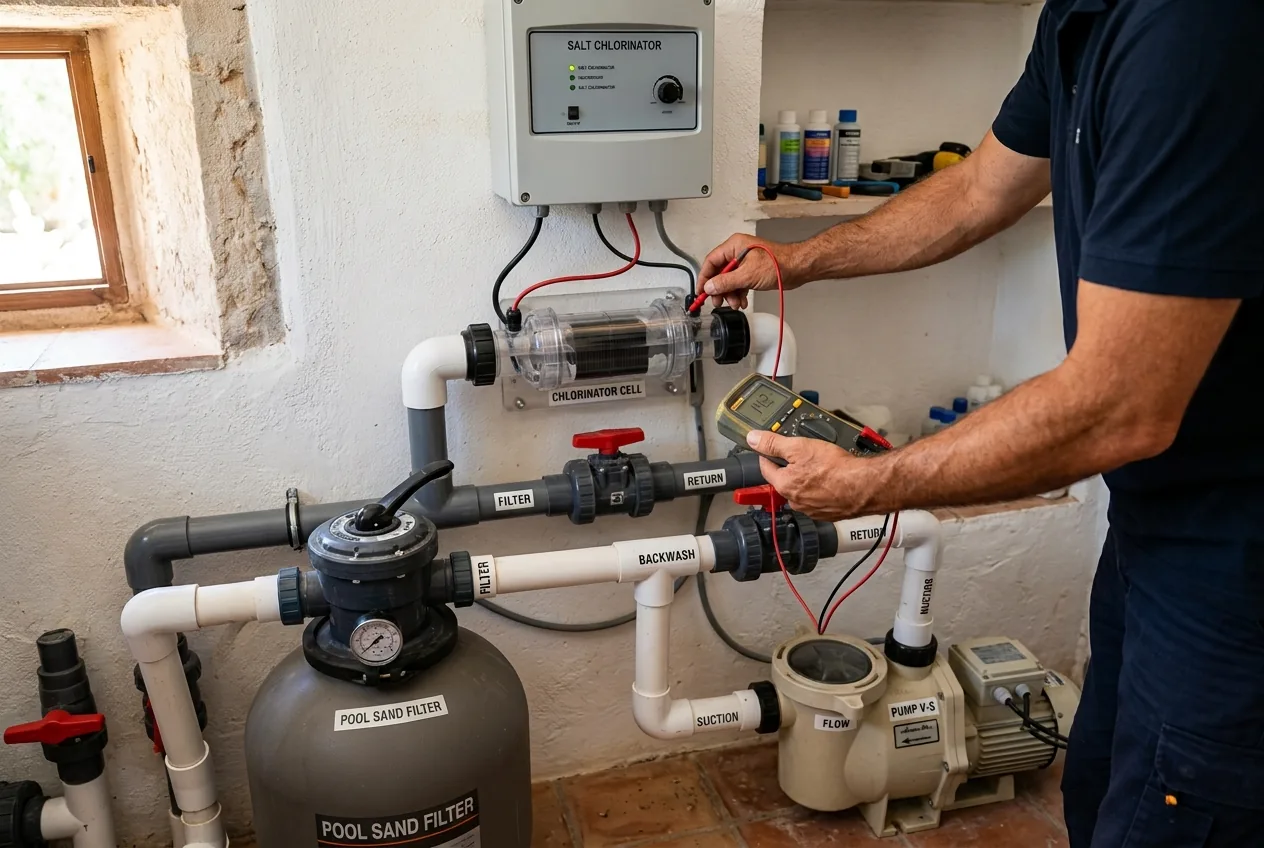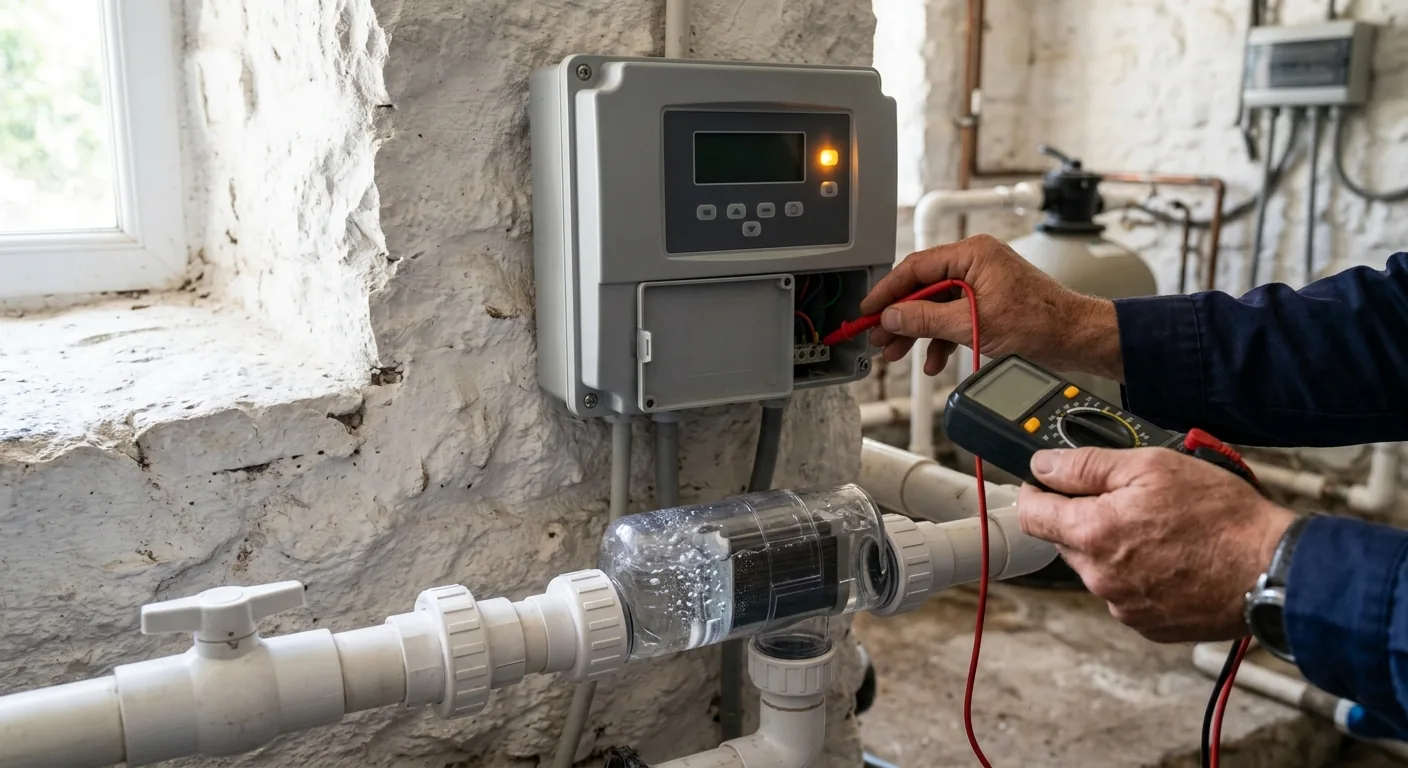
Three Spanish brands appear in many Mallorca pool rooms: Kripsol, now part of Hayward; AstralPool, part of Fluidra; and Idegis, from Alicante. Their alarms follow the same logic, flow, salt and cell, but the lights and wording differ by model. This guide covers the models most often installed in villas, based on the manufacturers' manuals.
Kripsol KLS: lights for flow and salt
The Kripsol KLS 20 and KLS 30 show faults with indicator lights:
- Flow light on: no water is flowing through the cell, so the unit does not work normally. Check the pump, the filter and the valves
- High salt or low salt light on, together with the fault light: the salt is outside the correct range. The manual asks for 50 to 60 kg of salt per 10 m³ of water, roughly 5 to 6 g/L
The manual also says to switch the chlorinator off while you add salt, until it has dissolved, because running it during dosing can damage the electrodes and the rectifier.
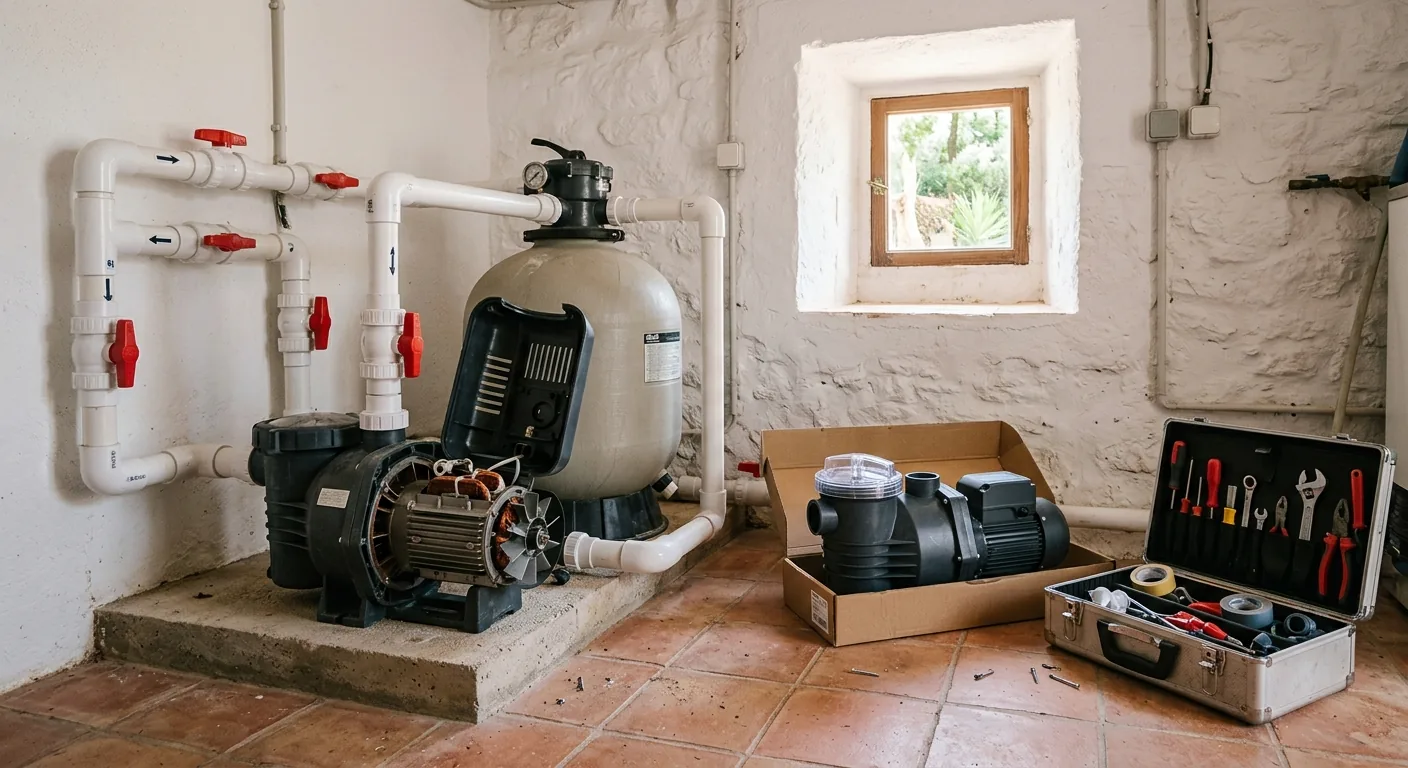
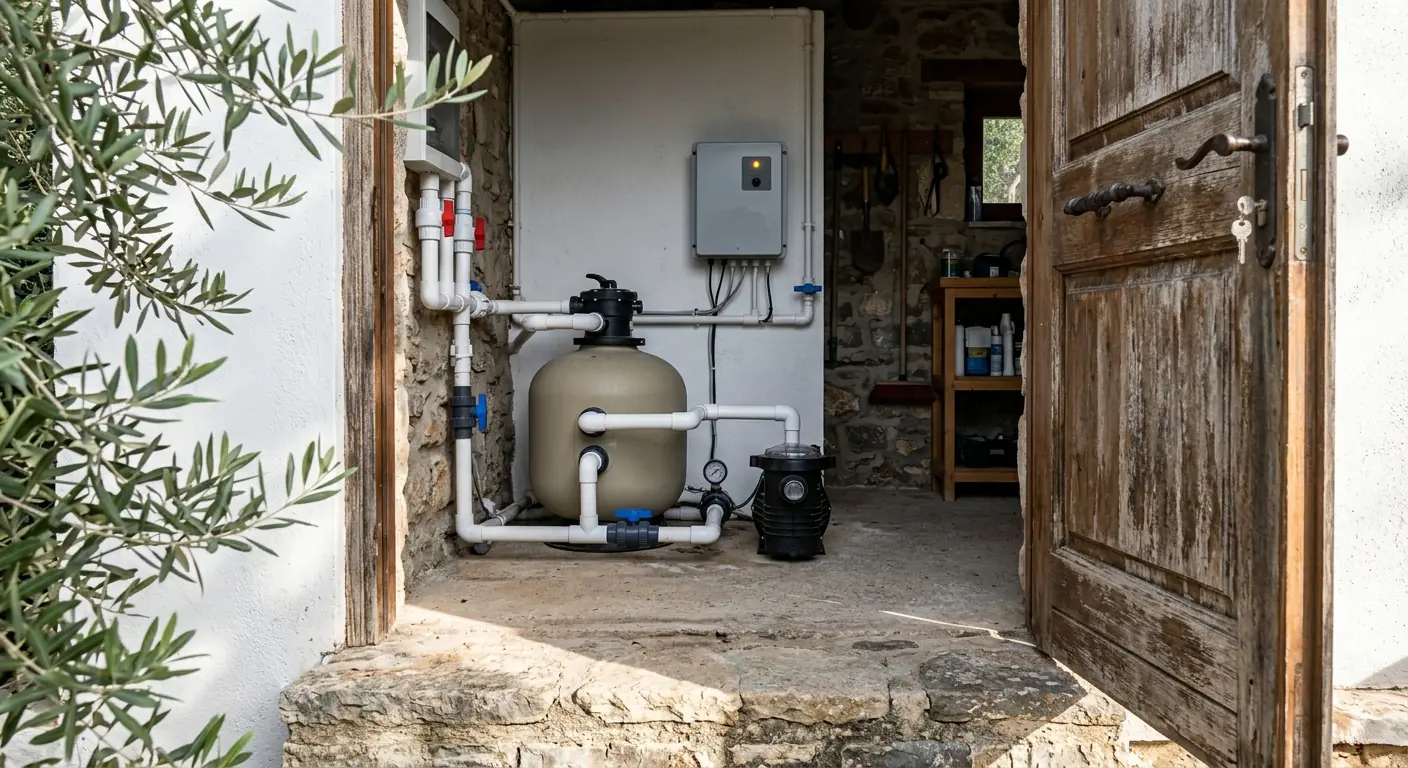
If the chlorine production meter reads low, the KLS manual lists three causes: too little salt, dirty electrodes or worn electrodes. If the chlorine in the pool is low although the unit seems fine, the running time may be too short, the stabiliser or salt too low, the pH too high or the electrodes dirty. Newer Kripsol KLX units are described with similar low salt and no flow alarms. Kripsol also makes sand filters such as the Granada and Artik ranges, and a pool technician can repair or replace their valves and sand as well.
AstralPool Smart: what the lights mean
On the older AstralPool Smart 30, 60 and 100:
- SALT light steady: the salt is too high and the output is reduced automatically. Drain about 10% of the pool, refill with fresh water and check with a salt meter
- SALT light blinking: the salt is low and the unit may not reach the selected output. It can also read falsely low below 20 °C or when the electrodes are near the end of their life. Measure the salt and add plain salt without additives
- All lights flashing: the gas or flow detector is not covered by water because of a gas bubble or no flow. Output stops until the flow returns, then the unit resets itself
- Production always at 0: check the electrodes, the connections between power supply and cell, and the salt level
The Smart works between 4 and 6 g/L of salt, and AstralPool recommends at least 5 g/L. Below 3 g/L the electrodes wear prematurely and the warranty does not cover it.
AstralPool Elite Connect and Idegis: text alarms
The current AstralPool Elite Connect and the Idegis Escalable range use a text display with very similar alarms:
- FLOW: the cell is not completely full of water, or no water is flowing. Check the pump, the filter, the selector or backwash valve, and the cables of the flow switch and gas sensor
- STOP CL with CL EXT or CL INT: production has been stopped by an external controller, or by the unit's own chlorine (ORP) reading reaching its limit. If no external controller is fitted, the AUTO CL EXT setting must be switched off, or production will not start
- Cell alarm: the electrode has reached the end of its life. On Idegis units heavy scale in hard, high-pH water can trigger it too, so clean the cell first; if the alarm stays, the electrode needs replacing
- Salt or conductivity LOW or HIGH: the salt or the water temperature is outside the set range. Very cold water lowers conductivity, so the unit cannot reach full output in winter
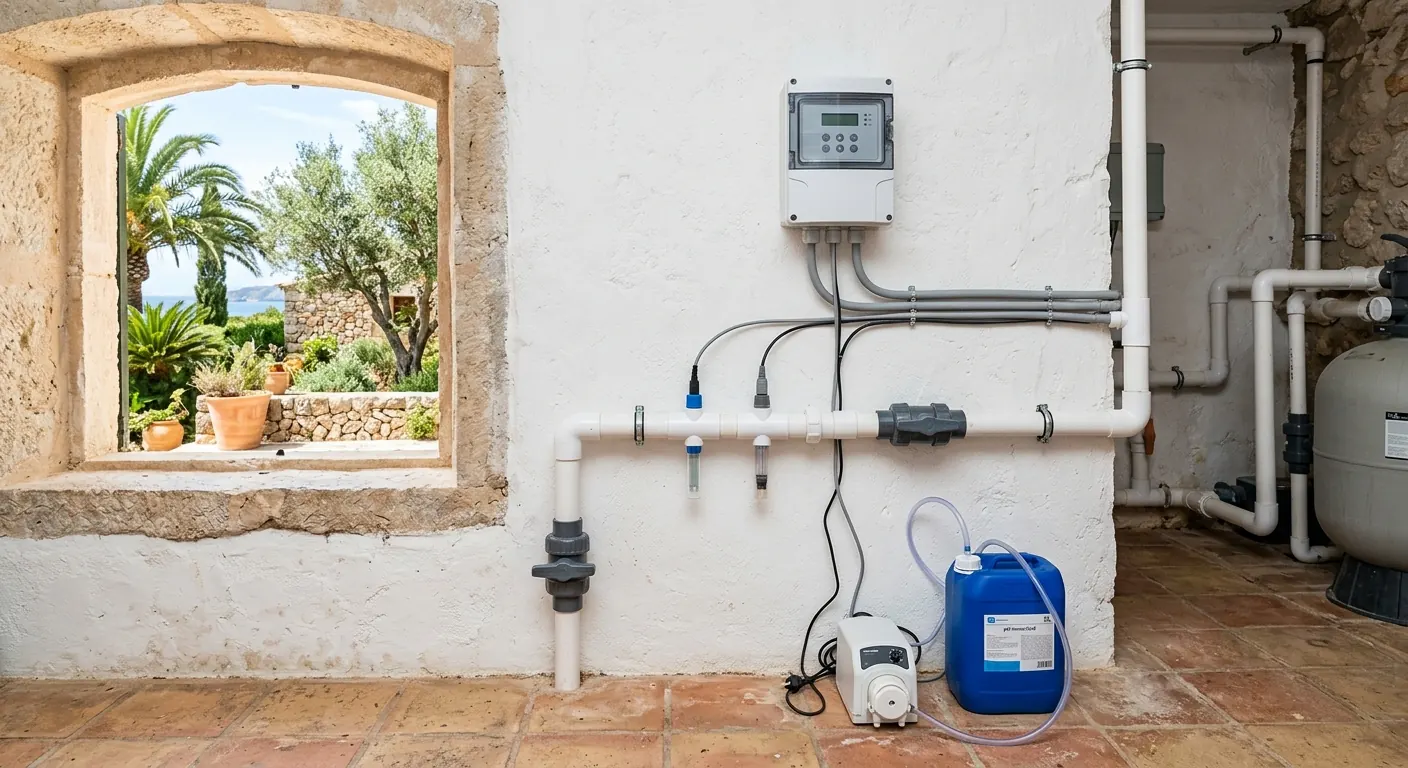
- pH and ORP alarms on models with dosing: the pH is above 8.5 or below 6.5, or the dosing pump has run for its maximum time, 60 minutes by default, without reaching the setpoint. Test the water, clean and calibrate the sensors and check the acid container
- FUSE on the Elite Connect: a blown fuse. Replace it only with the correct rating and genuine parts
Recommended salt: Elite Connect 4 to 12 g/L, with 5 g/L as the optimum (about 1.5 g/L for the low-salt LS models); Idegis 3 to 12 g/L, with 5 g/L recommended. Use plain salt without iodide or anti-caking agents, and add it to the pool, never through the cell.
Cleaning the cell
Most of these units reverse the polarity of the cell to limit scale, but Mallorca's hard water often means occasional manual cleaning. The instructions differ, so follow your own manual:
- AstralPool Smart and Idegis: 1 part hydrochloric acid to 10 parts water, for no more than 10 minutes
- Kripsol KLS: a solution of 8 parts water to 2 parts acid, enough to cover the cell but not its connections. The cell is clean when it stops fizzing; rinse it in fresh water straight away
- Always add the acid to the water, never the reverse, never scrape or brush the plates and keep the terminals dry
- Switch off the power and disconnect the cell before you remove it
AstralPool and Idegis point out that frequent acid cleaning itself shortens electrode life. In hard water it pays to keep the pH between 7.2 and 7.6, as AstralPool recommends, to limit scale in the first place.
When to call a technician
Call a technician when an alarm keeps returning after you have corrected the salt and the flow, when a cell alarm stays after cleaning, when a fuse blows again, or when the sensors will not calibrate. Electrode life varies a lot by model: AstralPool estimates 3,000 to 5,000 hours for the older Smart and about 18,000 hours for the Elite Connect Cellguard, while Idegis quotes 8,000 to 10,000 hours. A technician can tell you whether a new electrode or a new unit is the better buy. Our salt chlorinator repair page shows typical prices in Mallorca.