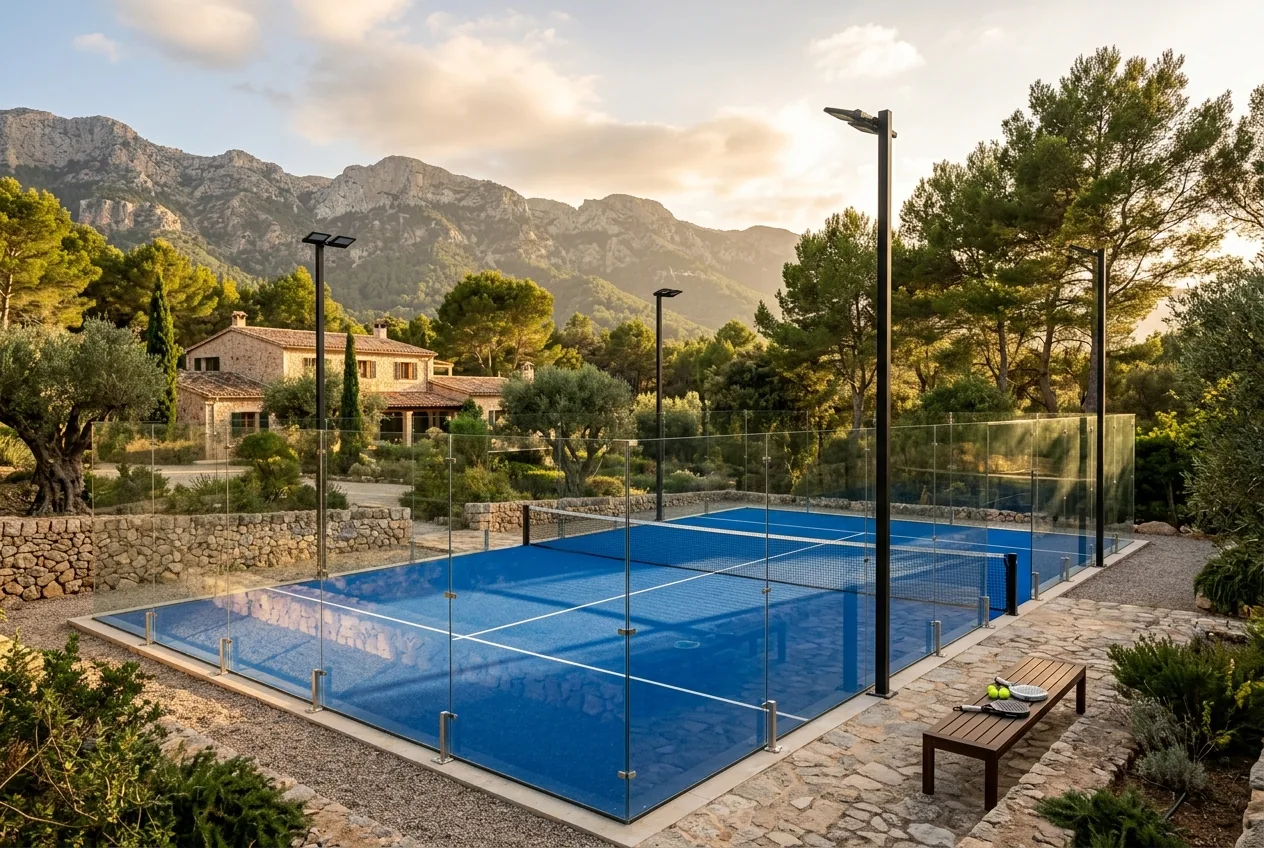
Yes, you can build a private padel court at a villa in Mallorca, but it is a construction project, not a garden accessory. You need a flat area of roughly 22 × 12 m, a solid concrete base, the right orientation and, in almost all cases, a licence from the council. Rules are much stricter on rustic land. A complete court with base and lighting typically costs €25,000–60,000 before IVA, depending on the type of court and how much groundwork your plot needs.
Why villa owners add a padel court
Padel is hugely popular in Spain and easy to pick up, so it works for every generation: children, grandparents and visiting friends can all play together after a few minutes. It is sociable, always played in doubles, and fits in a much smaller space than tennis.
For holiday rentals, a private court can help a villa stand out, particularly with families and groups of friends. It also gives guests something to do outside the hottest hours, especially if the court is floodlit. If you rent out your property, check how a court affects your insurance and house rules, and be realistic about noise near neighbours.
Panoramic or standard court
Both types use the same playing dimensions; the difference is in the structure.
- Standard court: the glass back walls are held by metal posts and frames, which are visible behind the glass. Usually the more economical option and very robust.
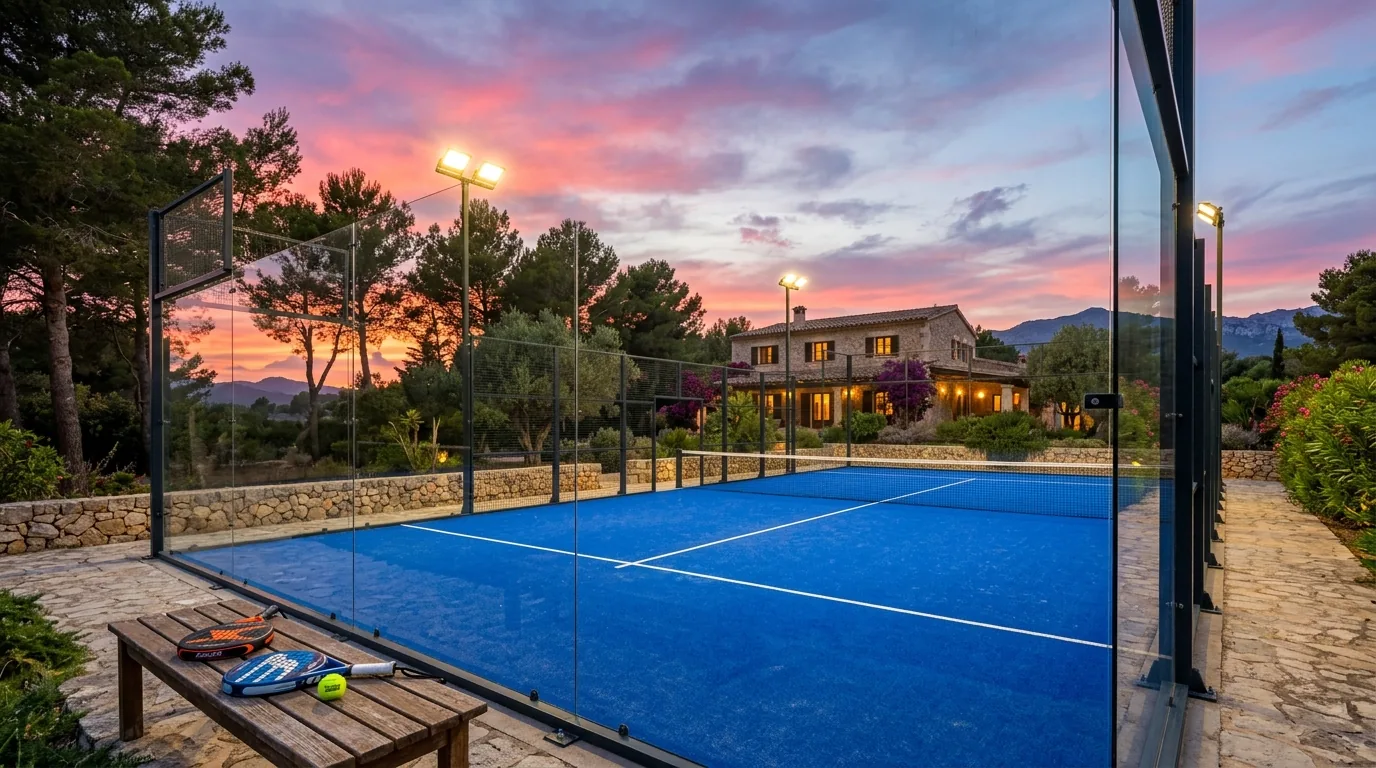
- Panoramic court: the glass is held by special fittings with no posts behind it, giving an almost uninterrupted view of the court and the landscape. It looks spectacular at a villa but costs more and needs very precise installation.
Both are surrounded by tempered safety glass at the ends and steel mesh along the sides. Near the coast, ask for a galvanised and powder-coated steel structure suitable for salt air, and stainless or well-protected fixings.
Space, orientation and groundworks
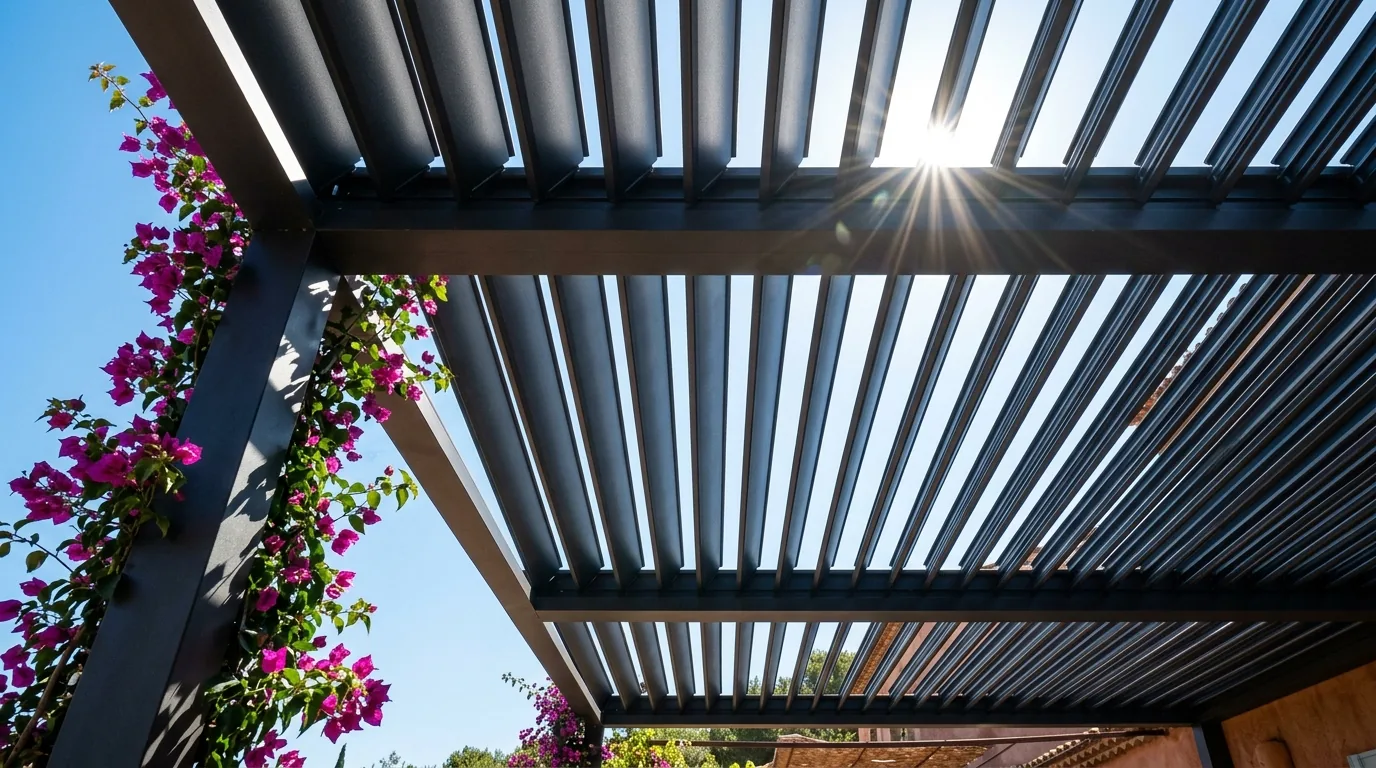
A padel court has a playing area of 20 × 10 m. Around it you need space for the structure, access and some clearance, so in practice plan for a flat platform of at least about 22 × 12 m, and more if you want seating, a path or a small shaded area beside it. A pergola next to the court is a popular addition.
Orientation matters. Courts are normally laid out with the long axis running north–south, so that the low morning and evening sun does not shine straight into the players' eyes. On many Mallorca plots this conflicts with the view or the slope, and a specialist can help you find the best compromise.
Mallorca's plots are often sloping, terraced or rocky. Creating a level platform may require excavation, retaining walls, imported fill and proper compaction, and this is where costs can vary most. Drainage around the platform is essential, especially on terraced land where water runs downhill after autumn storms.
Base and artificial grass
The court sits on a reinforced concrete slab, laid level or with a very slight slope for drainage, depending on the system. The slab must be well cured before the glass and surface go on, because cracks or unevenness will show through the grass and affect play.
The playing surface is usually sand-filled artificial grass designed for padel. Different fibre types change ball speed and grip, and some are better suited to strong sun and heavy use. Ask about UV resistance, warranty and how often sand needs topping up.
Lighting, noise and neighbours
LED floodlights on posts let you play in the cooler evening hours, which in a Mallorca summer is often the best time. Good lighting design keeps the light on the court and avoids glare towards neighbours and the night sky. Some councils have rules on outdoor lighting, particularly in rural and protected areas, so check before choosing the system.
Padel is noisier than tennis: the ball hitting the glass and the players' voices carry, especially in quiet countryside. Think about where the court sits relative to neighbouring houses and bedrooms, consider planting or walls as a buffer, and set sensible playing hours, particularly in rental villas.
Licence and timeline
A padel court almost always needs a licence or at least formal permission from the council (ayuntamiento), as it involves earthworks, a concrete slab and a fixed structure. On rustic land (suelo rústico) and in protected areas such as the Serra de Tramuntana, courts may be heavily restricted or not allowed, and lighting may face separate limits. Rules vary by municipality, so ask the council or your specialist before you commit, and make sure any project drawings are prepared by a qualified professional where required.
Timelines vary a lot. Once the permission is in place, groundworks and the slab usually take a few weeks, and the structure, glass and grass are often installed in a week or two, weather permitting. Permission itself can take considerably longer, so start early. Autumn and winter are usually the best time to build, so the court is ready for spring.
Costs
Typical ranges in Mallorca, before IVA:
- Padel court with base and lighting: €25,000–60,000
- Private tennis court, for comparison: €40,000–90,000
Where you land within the padel range depends mainly on panoramic versus standard glass, the amount of groundwork and retaining walls, lighting, and the quality of the surface. Project and licence fees are usually extra.
Compared with tennis, a padel court needs well under half the space (a tennis court with run-off needs a far larger platform), usually costs less, and is easier for mixed-ability groups. Tennis suits owners who already play seriously and have a large, flat plot.
Maintenance
Brush the artificial grass regularly to keep the sand evenly spread, and top up sand when needed. Clean the glass, and rinse the structure with fresh water if you are near the sea. Clear leaves and debris, check drainage before the autumn rains, and inspect fixings and the lighting once a year. Depending on use, the grass will eventually need replacing.
Getting quotes
You can describe your padel court project once on Mallorca Villa Experts, and up to 3 vetted specialists in your area will quote you directly. The service is free and there is no obligation to accept any quote.