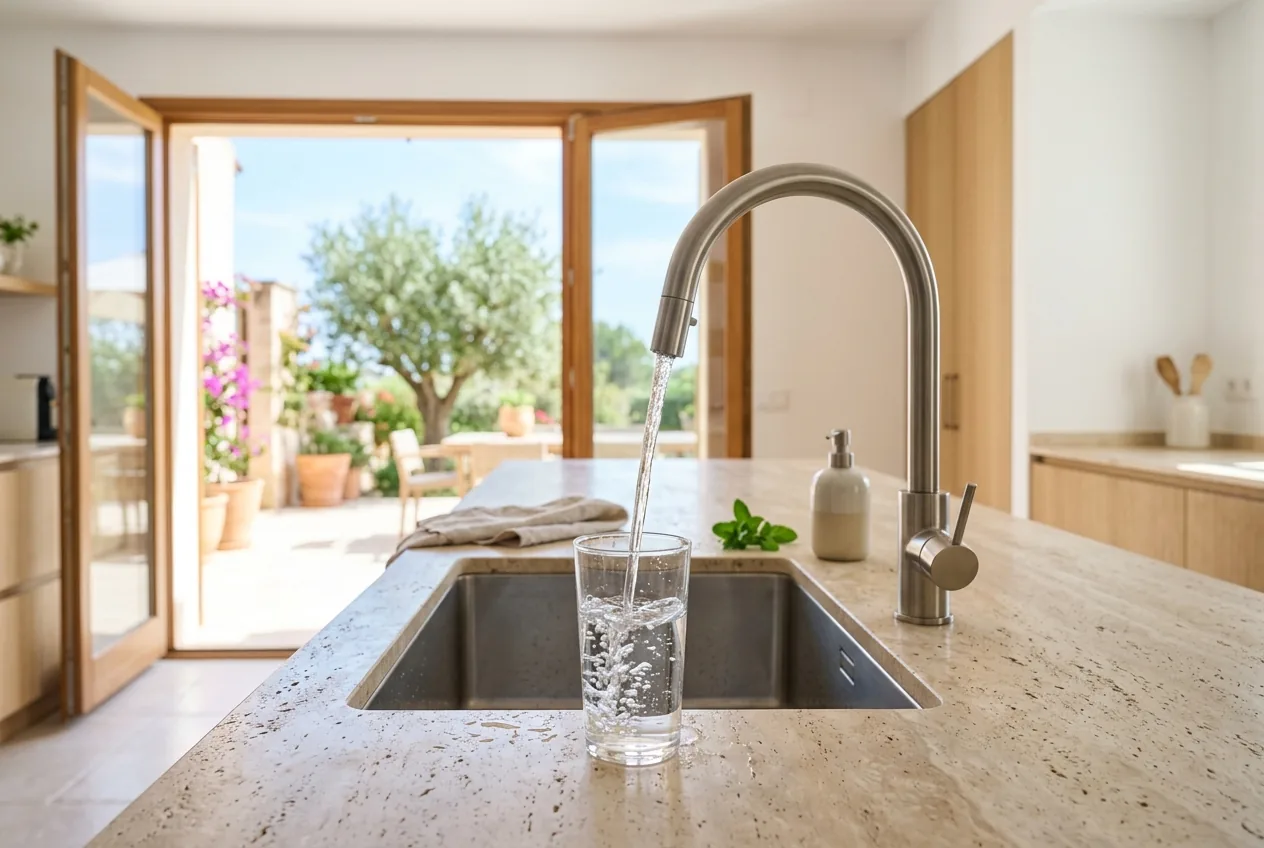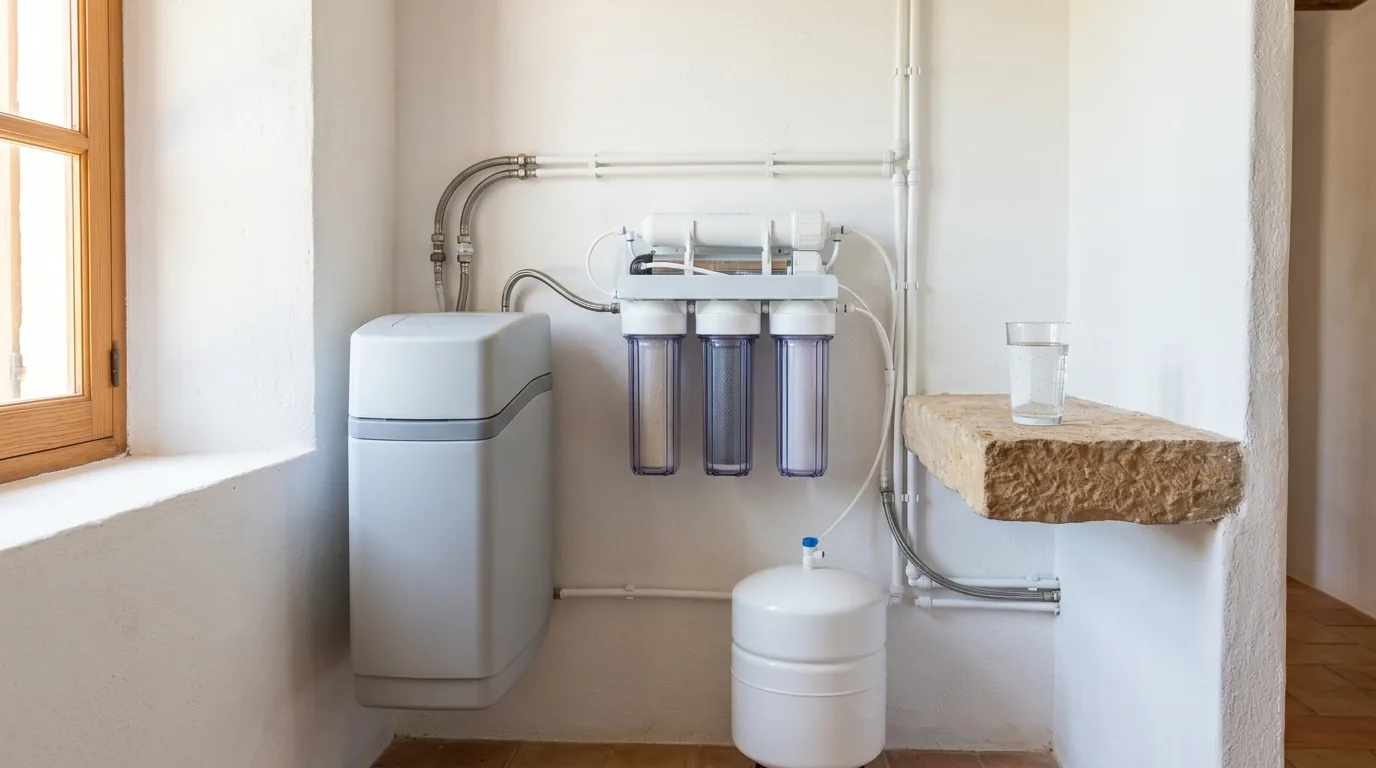
For most villas in Mallorca, a water softener is the answer to limescale and reverse osmosis is the answer to drinking water. A softener protects the whole house: boiler, heat pump, pipes, taps and glass. A small osmosis unit under the kitchen sink then gives you good-tasting water for drinking and cooking. Whole-house osmosis mainly makes sense where the source water is poor, for example a brackish well. The right choice depends on where your water comes from, so start with an analysis.
Why Mallorca's water is so hard
Much of the island sits on limestone. Rain filters through the rock into the aquifers and picks up calcium and magnesium, so both mains water and well water are usually hard or very hard. Near the coast, some wells also carry salt where seawater has seeped into overused aquifers. In summer, when some municipalities restrict supply or mix sources, the quality of mains water can change from one month to the next.
Hardness is not a health risk, but limescale is expensive. When hard water is heated or evaporates, it leaves a white crust:
- Boilers and hot water cylinders lose efficiency as scale coats heating elements and heat exchangers.
- Aerothermal heat pumps and their plate heat exchangers scale up, which reduces performance and can shorten their life.
- Taps, shower heads and thermostatic valves clog and start to drip.
- Glass shower screens, worktops and tiles get white marks that are hard to remove.
- Washing machines, dishwashers and coffee machines fail sooner, and pipes slowly narrow.
How a water softener works
A softener uses ion exchange. Water passes through resin beads loaded with sodium ions. Calcium and magnesium stick to the resin and sodium is released instead, so the treated water no longer forms scale. When the resin is saturated, the unit regenerates: it rinses the resin with brine from a salt tank, flushes the hardness minerals to drain and is ready again. Modern units regenerate according to actual water use rather than a fixed timer, which saves salt and water.
What a softener does:
- Stops new limescale throughout the house and gradually loosens existing scale.
- Protects boilers, heat pumps, appliances and taps.
- Helps soap and shampoo lather and makes glass and tiles easier to keep clean.
What it does not do:
- It does not remove salt, nitrates, bacteria, chlorine taste or sediment.
- It does not improve taste; softened water can taste slightly salty.
- It adds a little sodium, so many owners keep an unsoftened or osmosis tap for drinking.
How reverse osmosis works
Reverse osmosis pushes water through a very fine membrane that holds back most dissolved salts, minerals, nitrates and many other contaminants. It produces two streams: clean water, and a reject stream carrying the concentrate, which goes to drain.
Under-sink osmosis is the most common option. A compact unit in the kitchen feeds a separate drinking water tap and replaces bottled water for drinking, cooking, coffee and ice. Many include a remineralisation cartridge, because osmosis water is very low in minerals and can taste flat. Ideally it sits after a softener, so the membrane lasts longer.
Whole-house osmosis treats all the water entering the villa. It needs pre-filtration, a storage tank, a pressure pump and usually remineralisation, because very pure water can be aggressive towards metal pipes. It is generally only worthwhile where the source water is salty or high in nitrates, such as some coastal or agricultural wells, because it uses more energy and sends a significant share of the water to drain. In a municipality with summer restrictions, or in a villa relying on a cistern, that waste water matters.
Filtration and UV for well or cistern water
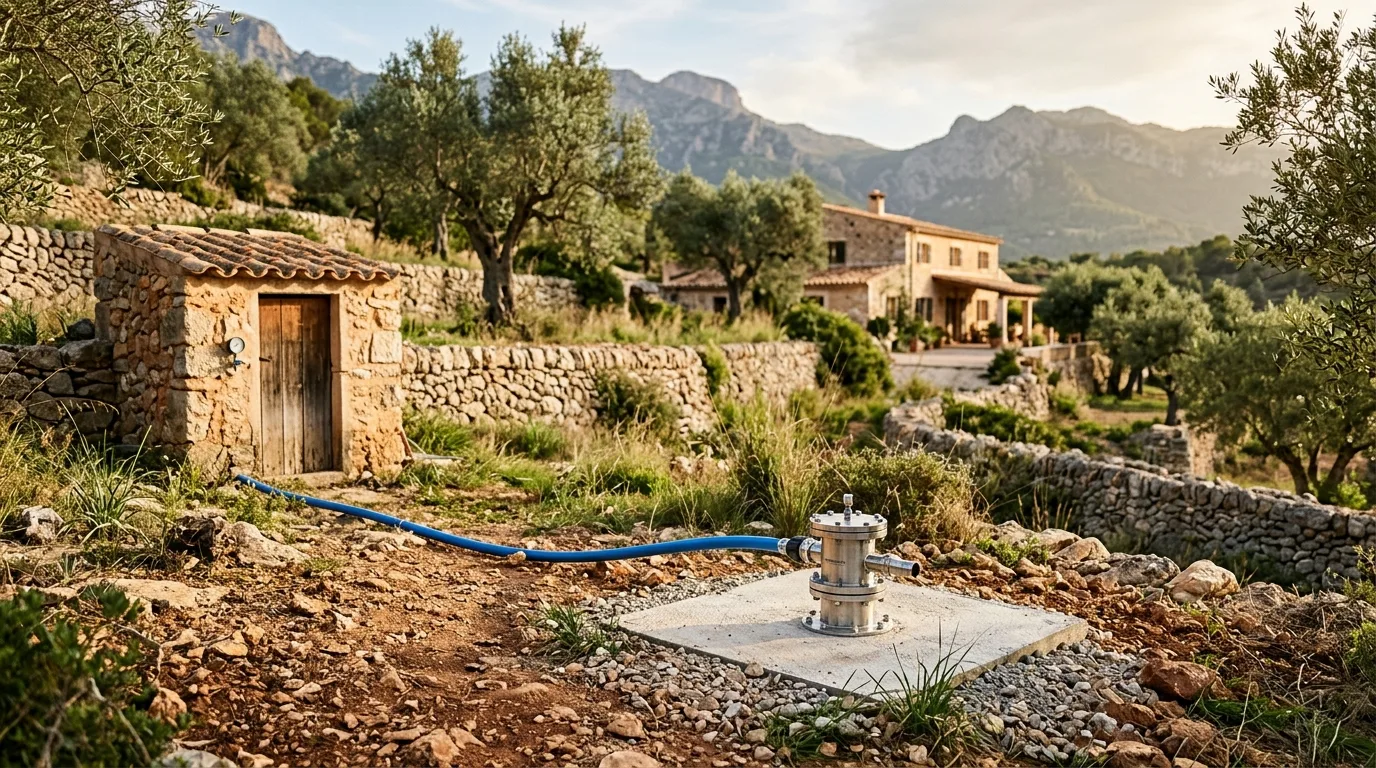
If your water comes from a well, a cistern or tanker deliveries, softening alone is not enough. A typical treatment line starts with sediment filtration to catch sand and particles, may include an activated carbon filter for taste, odour and some chemicals, and finishes with a UV lamp that deactivates bacteria and other microorganisms without adding chemicals. Roof rainwater is soft but still needs filtration and disinfection.
Which combination suits your villa
- Mains water, year-round home: a whole-house softener plus an under-sink osmosis unit for drinking water. This is the most common setup.
- Mains water, holiday home: the same setup works, but choose equipment that copes with long idle periods, with automatic flushing and a bypass.
- Well water that is clean but very hard: sediment filter, softener, UV and under-sink osmosis.
- Brackish or nitrate-rich well: pre-filtration, whole-house osmosis with remineralisation, UV and a storage tank sized for the house.
- Cistern or rainwater: filtration and UV first; a softener may not be needed if rainwater is the main source.
- Rental villas: guests notice taste and stains, and your responsibility for water safety is higher, so reliable disinfection and simple maintenance come first.
Start with a water analysis
Before buying anything, have the water tested by a laboratory. A useful analysis measures hardness, total dissolved solids, chlorides, nitrates, pH, iron and manganese, and for wells and cisterns the bacteriological quality. It tells the installer how to size a softener, whether osmosis is needed for the whole house or only for drinking, and which pre-filters will protect the equipment. For wells, repeat the test from time to time, because quality can change with the season and the water table.
Space, plumbing and maintenance
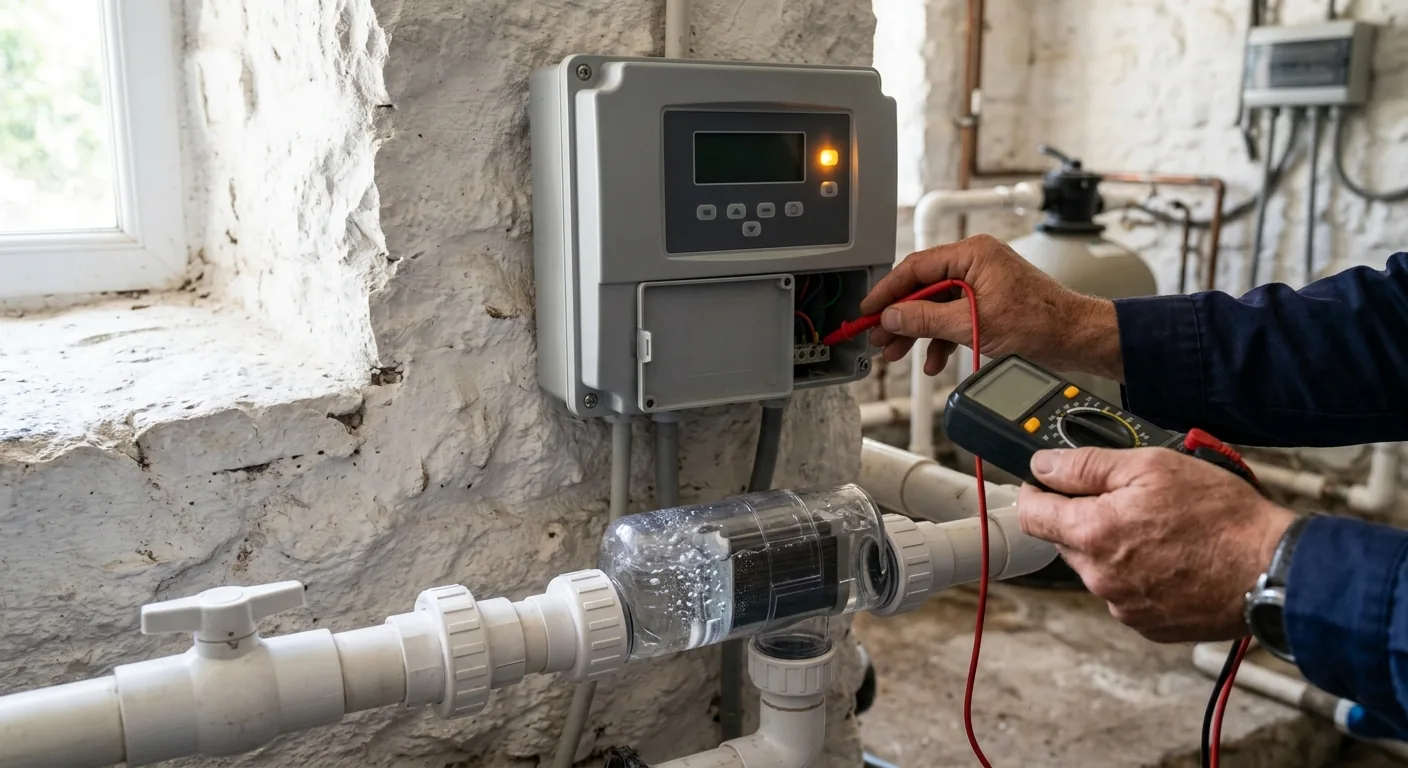
A softener needs a spot close to where the supply enters the house, usually a utility room, garage or plant room, with a drain and a power socket. Whole-house osmosis needs considerably more space for the tank and pump. A bypass lets the system be serviced without cutting the water, and an unsoftened line often stays for the garden and pool.
Maintenance is modest, but it has to happen:
- Top up the softener salt every few weeks or months, depending on use.
- Change sediment and carbon filters roughly every six to twelve months.
- Replace UV lamps about once a year and osmosis membranes every few years.
- Have the system serviced once a year, ideally before the summer season.
Empty houses are the weak point. Water standing for weeks in a softener or osmosis unit can encourage bacterial growth, so ask about automatic flushing, a sanitising visit before you arrive, or a maintenance contract with a local company that checks the system while you are away.
Costs
Typical ranges in Mallorca, before IVA (VAT):
- Water softener, installed: €1,200–3,500
- Whole-house reverse osmosis: €2,500–8,000
The final price depends on the size of the house and the number of bathrooms, your water consumption, the quality of the source water, how much pre-filtration and storage is needed, and how easy the plumbing connection is.
Getting quotes
On Mallorca Villa Experts you describe your project once, including your water source and any analysis you already have. Up to 3 vetted water treatment specialists in your area will then quote you directly, free and with no obligation.